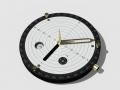
The SALAH Sundial
83,19 € excl. VAT
Product-Variations and Add-ons
The SALAH Sundial
Time Determination Diagrams
- Shipping costs included in Germany, EU and Switzerland on any order of 100 Euro or above
- Low price shipping outside the EU by registered letter
- 2 weeks statutory right of return (customised products excluded)
- Hotline: +49-611-185 11 06
Description
From Islamic Astronomy to the Modern Prayer Sundial
Around fourteen centuries ago, sundials played an important role in the Islamic world in determining prayer times. Careful observation of the Sun’s position and the calculation of prayer times contributed to the development of astronomy, making Islamic scholars important pioneers in the field of astronomy.
The SALAH Prayer Sundial carries this historical tradition forward. In a simple and intuitive way, prayer times throughout the day can be determined anywhere in the world by observing the position of the Sun.
At the same time, the SALAH can be used as a universal sundial. By measuring the shadow, it is possible to determine solar time as well as Central European Time (CET/CEST) or any other standard time. Location-specific diagrams for determining the time are optionally available for your home or holiday destination.
The Idea Behind the SALAH Sundial
The idea for the SALAH Sundial originated from a request by Mohammed Faris. The goal was to develop a portable sundial that could be used anywhere in the world, enabling Muslims to determine prayer times based on the position of the Sun.
Mohammed Faris is the founder of The Productive Muslim Company, an author, and an international speaker. His new book, “The Five Daily Resets – Using the Divine Gift of Salah to Unlock Your True Potential,” explores the significance of the five daily prayers and their role in everyday life.
Salah – Prayer Times in the Rhythm of the Sun
Salah (also Salāt) is the ritual prayer in Islam. It is performed five times a day, facing the Kaaba in Mecca, the Qibla, at prescribed times, and is one of the fundamental obligations (Fard) of Muslims.
The times of the five daily prayers are directly related to the position of the Sun at the respective location. From an early period onward, scholars in the Islamic world therefore devoted considerable attention to observing the Sun’s position. Sundials served as a valuable instrument for determining prayer times.
To this day, the Azān (also Adhān), the Islamic call to prayer, announces the beginning of a prayer time and, in particular, calls Muslims to congregational prayer. Traditionally, the call to prayer is given by the Muezzin.
Dhuhr and ’Asr – The Prayers in Broad Daylight
The prayer times of the two prayers performed in broad daylight, Dhuhr and ’Asr, can be ideally determined with a sundial. The SALAH Sundial is particularly well suited for this purpose.
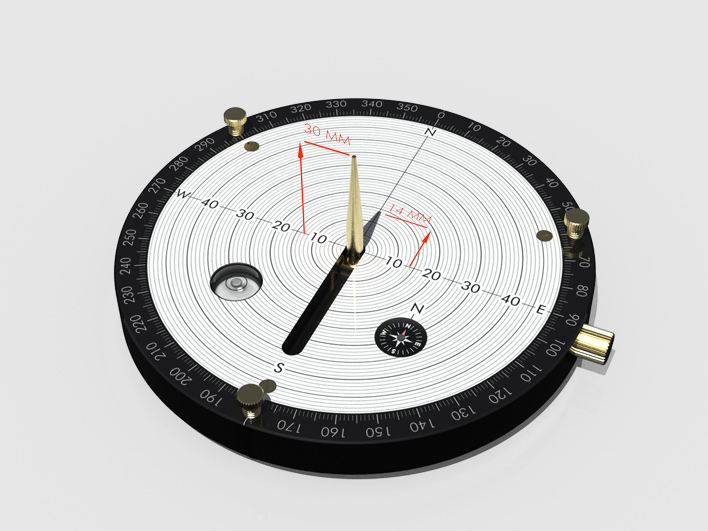
Following the historical tradition, the SALAH allows the beginning of each prayer time to be determined without relying on a clock, simply by measuring the length of the shadow. Determining the prayer times yourself from the movement of the Sun creates a direct connection between the prayer ritual and the Sun as a natural timekeeper.
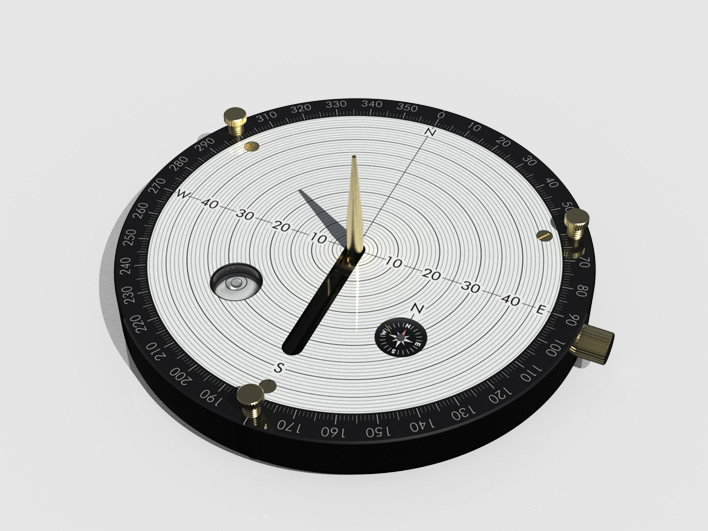
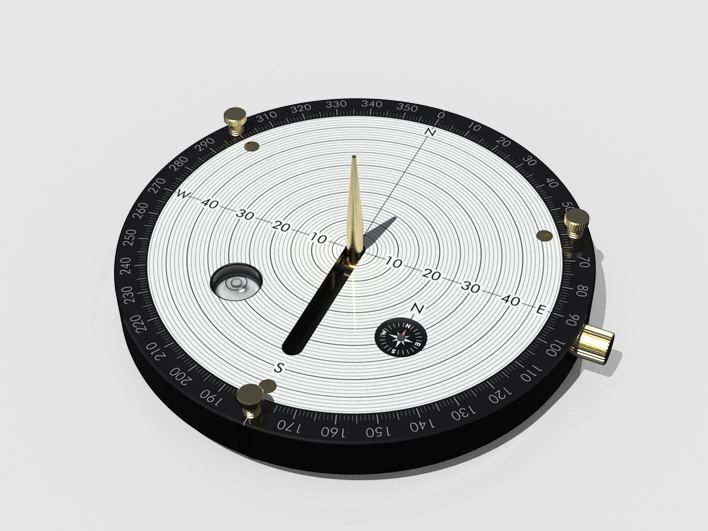
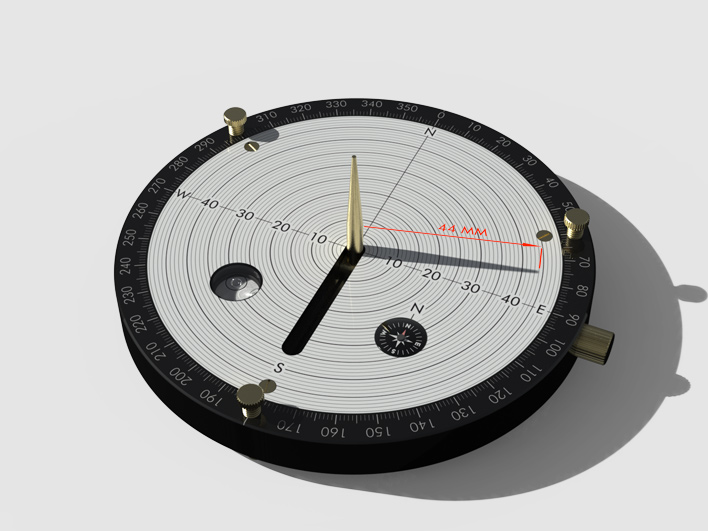
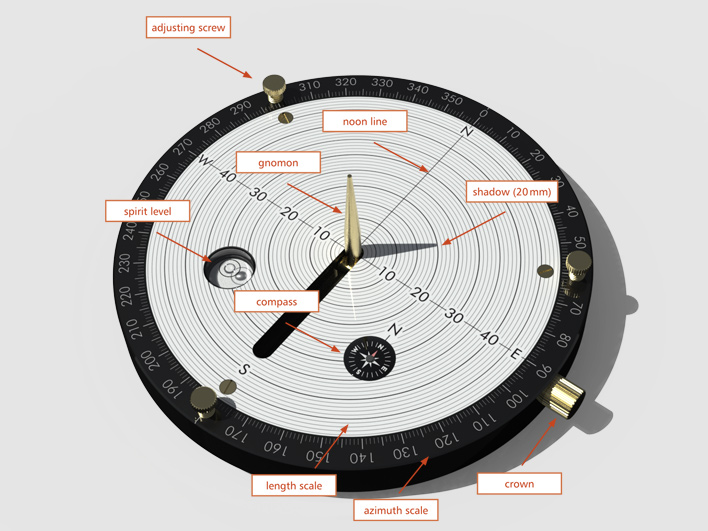
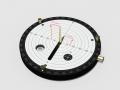
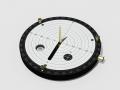
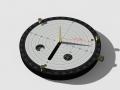
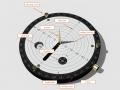
The SALAH Sundial is designed for mobile use at almost any location in the world. For transport, the gnomon is conveniently recessed into the body and simply folded out at the destination. The sundial is aligned using the integrated compass and then precisely levelled with three knurled screws.
The SALAH can be used regardless of latitude or season. This is made possible by four interchangeable gnomons with different lengths of 5, 10, 20 and 30 mm. This allows the sundial to adapt to different solar elevations and to be used reliably when the Sun is high or low in the sky.
The richly illustrated manual explains step by step how to set up the SALAH Sundial and use it to determine Islamic prayer times. Even easier is our two-minute video tutorial, which clearly demonstrates the function and operation of the SALAH Sundial.
Alternatively, you can also find the video on YouTube
Prayer Times Determined by Observing the Horizon
The following prayer times are determined not with the sundial, but through direct observation of the sun and the signs of twilight on the horizon.
The Maghrib prayer (evening prayer) begins shortly after sunset, when the sun’s disk has completely disappeared below the horizon. It ends with the beginning of Ischā time, when the evening twilight has disappeared from the horizon.
The Ischā time ends with the onset of true dawn, marking the beginning of the Fajr prayer (morning prayer). Fajr lasts until sunrise and is also referred to as Subh prayer time.
Determining the Noon Line and the Qibla
The circular scale allows the shadow length to be measured in any direction, regardless of the orientation of the sundial. Therefore, prayer times can be determined even when the SALAH Sundial is not precisely aligned with north.
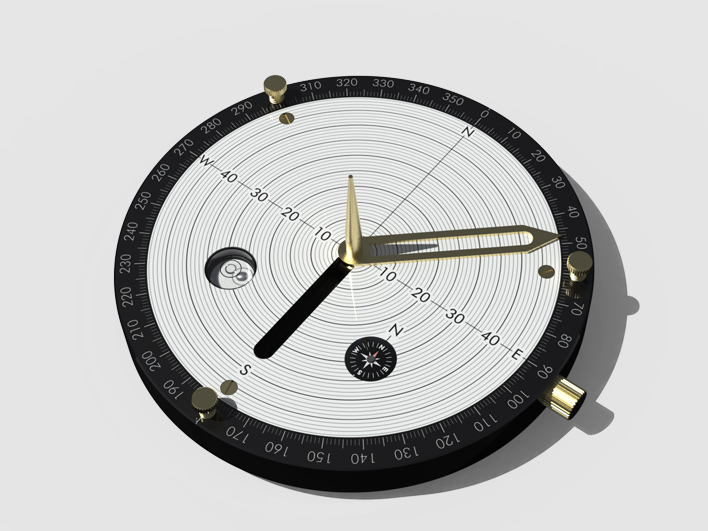
For the precise determination of the prayer direction towards the Kaaba in Mecca, known as the Qibla, the sundial can be accurately aligned along the north–south direction. To do this, the supplied pointer is attached. In the morning and afternoon, the angle at which the shadow reaches a specific length is measured. The angle bisector between these two measurement points corresponds precisely to the north–south direction, known as the noon line.
This method is a further development of the historical Indian Circle method – a graphical technique for determining the north–south direction using a compass, ruler and pencil.
The Qibla is the prescribed prayer direction of Muslims towards the Kaaba in Mecca, the holiest sanctuary in Islam, wherever a believer may be located on Earth.
Once the Qibla angle (azimuth) measured from north is known for a particular location, the supplied pointer is set to the corresponding degree on the scale. The direction indicated by the pointer then shows the direction in which to pray.
If the SALAH Sundial is used permanently at the same location, accurately aligning the noon line also offers an advantage when determining solar noon. Solar noon occurs when the shadow reaches the noon line. As the shadow subsequently moves beyond the noon line, the Sun begins to descend again (Zawāl). This marks the beginning of the Dhuhr prayer (noon prayer).
Use as a Sundial for Worldwide Applications
In addition to being used as a prayer sundial, the SALAH Sundial can also be used to determine solar time from the length and direction of the shadow. Its major advantage is that it can be used worldwide, regardless of latitude.
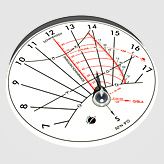
Using location-specific diagrams calculated for your chosen location, you can determine solar time by measuring the length and/or direction of the shadow. The instructions provided with the diagrams explain step by step how to carry out the measurements and determine the time.
You will also receive a time-difference table calculated for your location. This allows you to convert solar time (local apparent time, LAT) into standard time.
For use as a prayer sundial, the diagrams also show the shadow-length curve indicating the beginning of the ’Asr (afternoon prayer) time.
Documents and links
A detailed, illustrated manual for the SALAH sundial, with a foreword by Mohammed Faris
Instructions for SALAH Sundial Diagrams
Diagrams for determining solar time, using Berlin as an example.
Time difference table for determining CET/CEST based on solar time, using Berlin as an example
More products by Helios